
How the PV system, the Enphase batteries and the solar-thermal collectors fit together, and why we chose microinverters
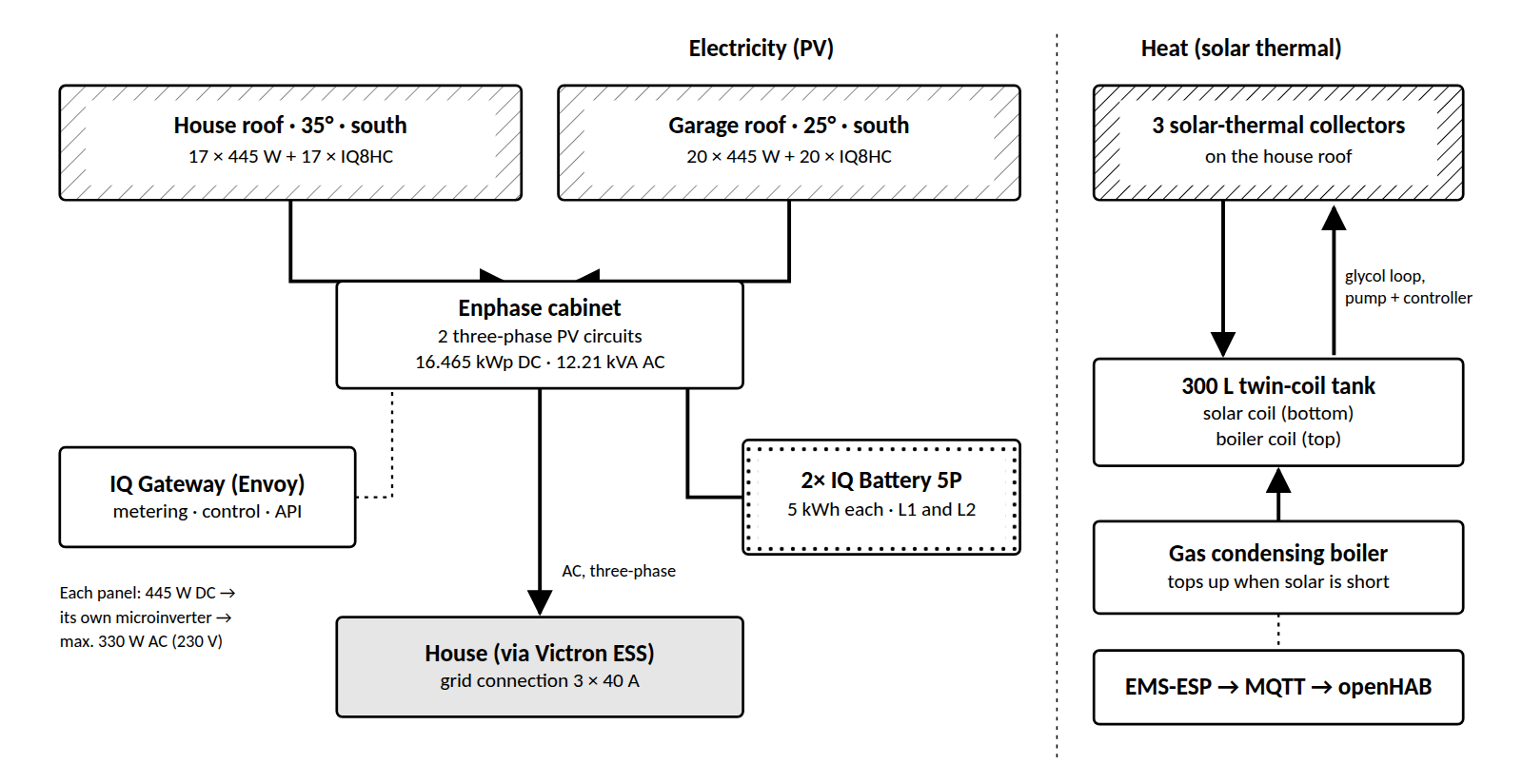
In short. 37 panels of 445 W (16.465 kWp) on two south-facing roofs, each panel on its own Enphase IQ8HC microinverter, limited to 330 W AC, which adds up to exactly the 12.21 kVA injection limit agreed with the grid operator. Two Enphase IQ Battery 5P store midday surplus, and three solar-thermal collectors heat the domestic hot water. Since September 2026 the whole Enphase system sits behind a three-phase Victron storage system, described in a separate post.
1. The roofs and the panels
The array was commissioned in January 2025 and covers two roof planes, both facing south (azimuth about +2°):
- House roof, 35° tilt: 17 panels, alongside the three solar-thermal collectors.
- Garage roof, 25° tilt: 20 panels, partly shaded by the house’s gable wall in the afternoon.
Each 445 W panel feeds its own IQ8HC microinverter, and each microinverter is limited to 330 W AC. That makes 16.465 kWp DC against 37 × 330 W = 12.21 kVA AC, a DC/AC ratio of about 1.35, and the AC figure is exactly the injection limit in our grid contract. The over-panelling is deliberate. When a panel could deliver more than its microinverter is allowed to pass on, the excess is simply cut off; this is called clipping. We accept it knowingly: it only costs energy on clear summer middays, when every panel runs into its 330 W ceiling, and that is the time of day when electricity is worth least anyway. In return, the larger panels deliver more in low light. Together with the microinverters’ low start-up voltage, each panel starts producing earlier in the morning, keeps going later in the evening and yields noticeably more on overcast days and in winter. For a household that needs its electricity in the mornings, evenings and the dark months, those kilowatt-hours are worth far more than the clipped midday peak.
2. Why microinverters
The picture below shows the live per-panel view at about 13:00 in June, next to a photo of the garage roof at the same moment. The gable wall of the house casts its shadow on the panels nearest to it: panels 14, 20 and 26 deliver 42–50 W, panels 15 and 21 deliver 164–200 W, and panels 27 and 32 about 260 W, while their unshaded neighbours sit at 293–297 W. Panels 1–13 read 299–300 W; at that moment the sun, not the 330 W limit, set the ceiling.
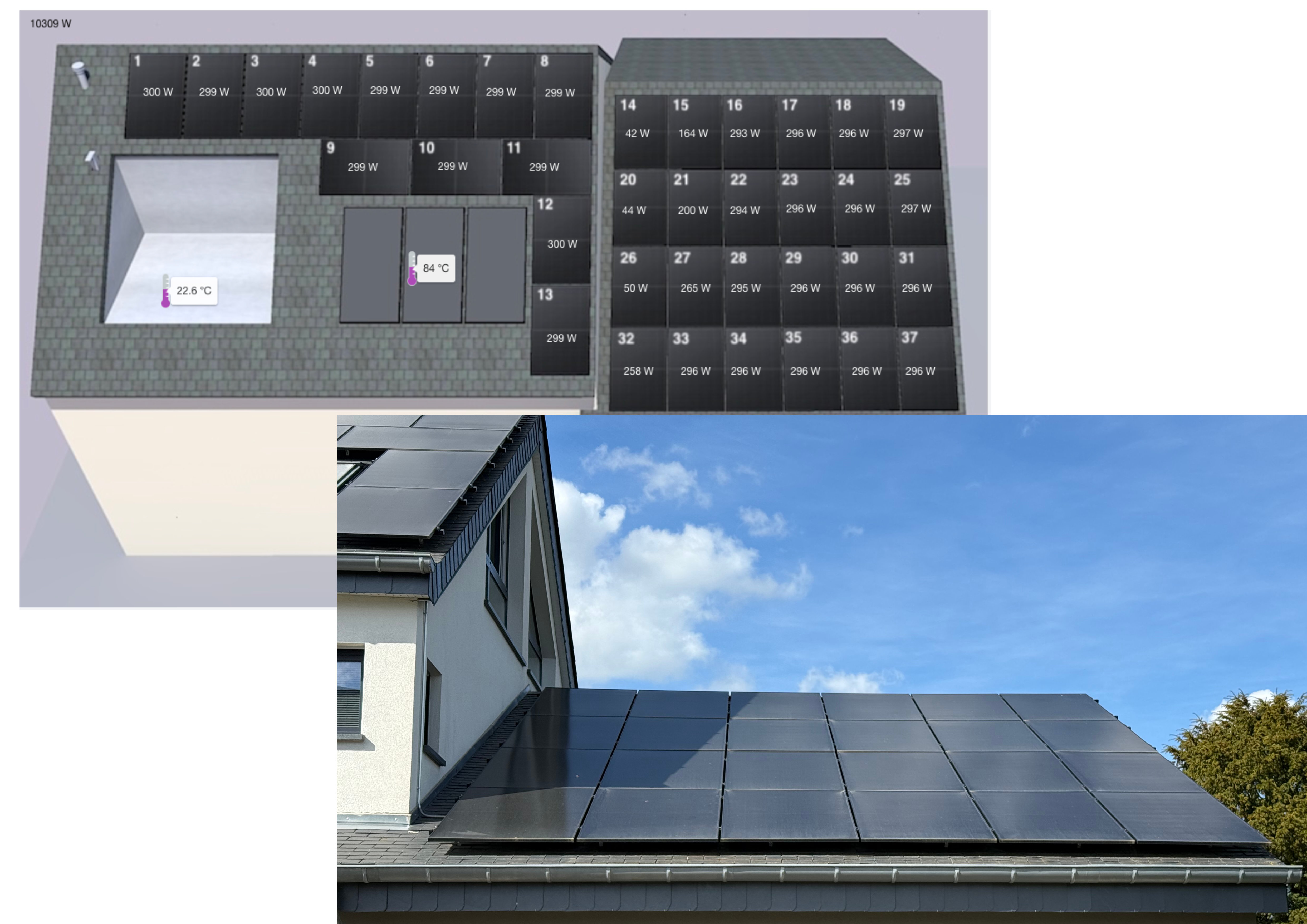
With microinverters each panel delivers whatever its own light allows. In this snapshot the shadow costs about 1 kW, roughly a tenth of the total, and not a watt more. In a series string the current is set by the weakest module. Bypass diodes and a global MPP tracker prevent the worst, but they do it by giving up the shaded sub-strings, so a large part of the roughly 1 kW that the seven shaded panels still deliver here would be lost as well. And this is the gentle case: at midday in June the sun is at its highest. In spring, autumn and winter the shadow is longer and stays on the roof for a larger part of the day.
Shading was not the only argument:
- Two roof planes with different tilts: no need to match strings to MPP trackers.
- Panel-level monitoring: Figure 2 is the proof. A failing panel or a new shadow is visible at a glance.
- No high-voltage DC on the roof: each microinverter turns its panel’s output into 230 V AC right behind the module, which makes fire safety and rapid shutdown simpler.
- Over-panelling per position: each panel clips on its own, so the 1.35 DC/AC ratio costs nothing on shaded positions.
The counter-arguments, for fairness: power optimisers (e.g. Tigo, SolarEdge) also solve shading, usually at a lower cost per watt, and a string inverter with a DC-coupled battery would have made the later Victron retrofit considerably simpler. Microinverters were the right answer for the roof; as the Victron post shows, the price is paid in the basement.
3. The Enphase batteries
Two IQ Battery 5P units (5 kWh each) sit next to the gateway in the Enphase cabinet. They are connected to phases L1 and L2; L3 has no battery. That is not an oversight but the result of two constraints at the time of installation. First, the Luxembourg state subsidy for home batteries was capped at 12.5 kWh of storage capacity: two 5 kWh units fit, a third would have pushed us to 15 kWh. Second, Enphase’s batteries were single-phase at the time of buying, so each unit could only serve the phase it was connected to, and with two units one phase had to go without. In daily life this costs nothing, because the Luxembourg smart meter does phase netting: it sums the energy of all three phases before billing. The IQ batteries cover L3’s consumption by exporting the same amount on L1 and L2; physically, L3 still draws from the grid, but on the bill the two cancel out. That only works while there is a grid to do the netting. On their own, the Enphase batteries could not help during an outage at all, since they cannot run without a grid. In our house, the Victron system’s three MultiPlus units share one DC bus, so in island mode the transfer happens through the batteries instead: surplus on L1 and L2 charges the shared bus, and the L3 MultiPlus converts it back on L3, at the cost of two conversion stages and within each unit’s continuous rating. Once the Enphase clamps move to the Victron AC output, the same detour can also happen while the grid is present, whenever the Victron batteries are not full: whether the Enphase gateway can be told to stop netting the phases is still to be solved. The IQ batteries charge from PV only, never from the grid, and run in Enphase’s self-consumption profile: store the midday surplus, cover the house in the evening.
Two limitations matter. First, without Enphase’s own backup hardware the IQ batteries follow the grid; they cannot keep the house running during an outage. That role now belongs to the Victron system. Second, the gateway regulates them against its own current clamps. Once a second storage system is in the house, those clamps decide which battery serves which load, and if both systems regulate the same point they happily charge each other. How we deal with that is described in the Victron post.
4. Solar thermal for hot water
Three solar-thermal collectors on the house roof heat a 300-litre twin-coil hot-water tank through a glycol loop: the solar coil sits at the bottom, the gas condensing boiler’s coil at the top and tops up when the sun is not enough. Figure 2 happens to show them at 84 °C at midday.
One lesson from the past: the solar circuit pump once stopped without anybody noticing. Because the boiler tops up the tank anyway, hot water kept coming and nothing seemed wrong. Since then an EMS-ESP gateway reads the heating system’s bus and publishes collector, tank and pump data via MQTT to openHAB, and a watchdog rule that raises an alarm when the collector is hot but the tank does not warm up is next on the list.
5. Grid connection and délestage
- Connection: three-phase, 3 × 40 A (27.71 kVA) with the DSO, Creos.
- Injection limit: 12.21 kVA, matched exactly by the microinverters’ combined AC limit.
- Feed-in: surplus is sold through a Luxembourg energy cooperative.
- Délestage: the DSO can curtail production through a relay in the smart meter. That signal is purely binary. Today it switches the PV off completely through external relays; the plan is to wire it to a digital input of the IQ Gateway instead, which then reduces output to 30 %, the response the DSO accepts from systems that can modulate.
6. Monitoring
- Enphase app (cloud): the per-panel view in Figure 2, history and alerts.
- IQ Gateway local API: openHAB reads the gateway on the LAN, no cloud involved. Access needs a token with a limited lifetime; when it expires, the data silently freezes, so the renewal date goes in the calendar.
- openHAB and Grafana: a nightly export stores PV production alongside the rest of the house’s energy data; the IQ batteries’ state of charge is read live.
- Victron: since the retrofit, a Victron energy meter also measures the Enphase PV output in real time for the storage system’s control loop.
7. Lessons
- Look at the roof at different times of day and year before choosing the inverter technology. In our case, one gable wall made a strong case.
- Over-panelling against a fixed AC limit is cheap energy outside the summer midday peak.
- Monitor what you cannot see: a dead solar pump and an expired API token both fail silently.
- If you might add storage later, think about where the gateway’s current clamps sit before the second system arrives.
Comments and corrections are welcome.